harry haslam - the boss
By Will Foster
There’s not many figures in the history of Luton Town who
can link together Bobby Robson, Malcolm Macdonald, The Oak Road Shop and Diego
Maradona. But then, Harry Haslam was never particularly ordinary.
He was born in Manchester in 1921 and began as a robust,
attacking full-back in the Manchester United youth set up. He would join
Rochdale as an amateur after the war and then embark on a short career in the
Football League with Oldham, Brighton and Leyton Orient.
It wasn’t long before he’d moved into scouting and coaching.
An early influence was England international full-back Jack Tresadern, who
hired Harry as Chief Scout at Hastings United and who he suceeded as Tonbridge
manager in 1960 after Tresadern’s passing.
Sandwiched between this was a spell as manager of Barry in
the Welsh League, where Haslam was perhaps most famous for signing a handful of
Nordic internationals who were looking for games before the 1960 World Cup.
At Tonbridge, inspired by his time at Old Trafford, Haslam
set about replicating the Busby Babes youth model. He inaugurated a Juniors and
Colts side which quickly signed up 40 local players from the strongest youth
teams in the area. It was no surprise therefore that it was Haslam called by
Knole Juniors’ George Piper with word of a 17-year-old full-back that was worth
a look. Haslam agreed, and signed the young Malcolm Macdonald for Tonbridge in
time for the 1966/67 season.
A left-back, Macdonald’s route into the first team was
blocked by Vic Akers, who would go on to play for Cambridge and Watford.
‘You’ll play right back son,’ Haslam would tell his new player, ‘that’s your
position for the new season. If you don’t like it, tough. Look at it this way –
I’m teaching you to kick with your right foot!’
Harry’s importance in the career of ‘Supermac’ cannot be
understated. He became a friend of the family, telling Malcolm’s Mum, ‘I’ll try
everything in my power to get him in as a full-time pro, and then we’ll see how
it goes.’ For his part Macdonald was happy for Haslam to guide his career,
including the suggestion of trying out a few games in the forward line!
Haslam would remain in charge at Tonbridge for 522 games
over eight years before taking up the role of Chief Scout at Fulham in 1968
under a young Bobby Robson, himself taking a first real job in management. He
took Macdonald with him to Craven Cottage, though the time in London would
prove to be miserable for all three. Haslam would leave when Robson was sacked
after only 10 months in charge, and soon Macdonald found himself frozen out
after getting himself on the wrong side of club legend Johnny Haynes.
It was Harry that Macdonald would call for advice when he
became desperate to leave. Haslam’s advice was simple, if somewhat risky. He
told his protégé to demand a meeting with chairman Tommy Trinder and say, ‘if
you don’t let me go, I’m going to stick Johnny Haynes up against a wall and
beat the living daylights (a less polite word was actually used) out of him.’
The plan worked. And as it happened, the club most
interested in Macdonald was Luton, where Haslam had joined Alec Stock’s backroom
staff! The meeting to obtain his signature was delayed after Stock’s car
suffered a puncture, hence the reason for Haslam arriving in a grease covered
shirt after changing the wheel at the roadside.
In Alec Stock, Haslam had found a kindred spirit – one
similarly unafraid to challenge conventional football wisdom. Harry’s first
role at Kenilworth Road was suitably unusual – ‘Entertainments Manager and Chief Scout’ –
and he was based in what was then known as the ‘Luton Town Sports Shop’ on the
corner of Oak Road. He took both parts of the job very seriously and was at the
forefront of a number of commercial initiatives, such as the Hatters’ Club and the
Bonanza Girls hired to sell raffle tickets.
These were good times at Kenilworth Road. Buoyed by the
financial backing of Tony Hunt, who’s V&G insurance company was booming
thanks to the novel idea of offering ‘no claim discounts’, and by the goals of
a certain Malcolm Macdonald, Town were promoted into the 2nd Division in 1970.
In the background Haslam was starting to make an impression in the scouting
side of his job too, his signings including a 19-year-old from Hendon by the
name of Peter Anderson.
However, being Luton, turmoil wasn’t far away. Following a
1-0 win at Portsmouth in April 1971 news began to break of a collapse in
V&G shares. It would result in the resignation of Tony Hunt and the club
being placed in recievership. Forced to sell his best players, including
Macdonald, Alec Stock soldiered on for a year before the toil on his health
became too much and he resigned with a a single match left of the 1971/2
season.
Fortunately the club had a seemingly perfect replacement in house. At 51, and after years in the non-league game, Harry Haslam was going to become a Football League manager at last.
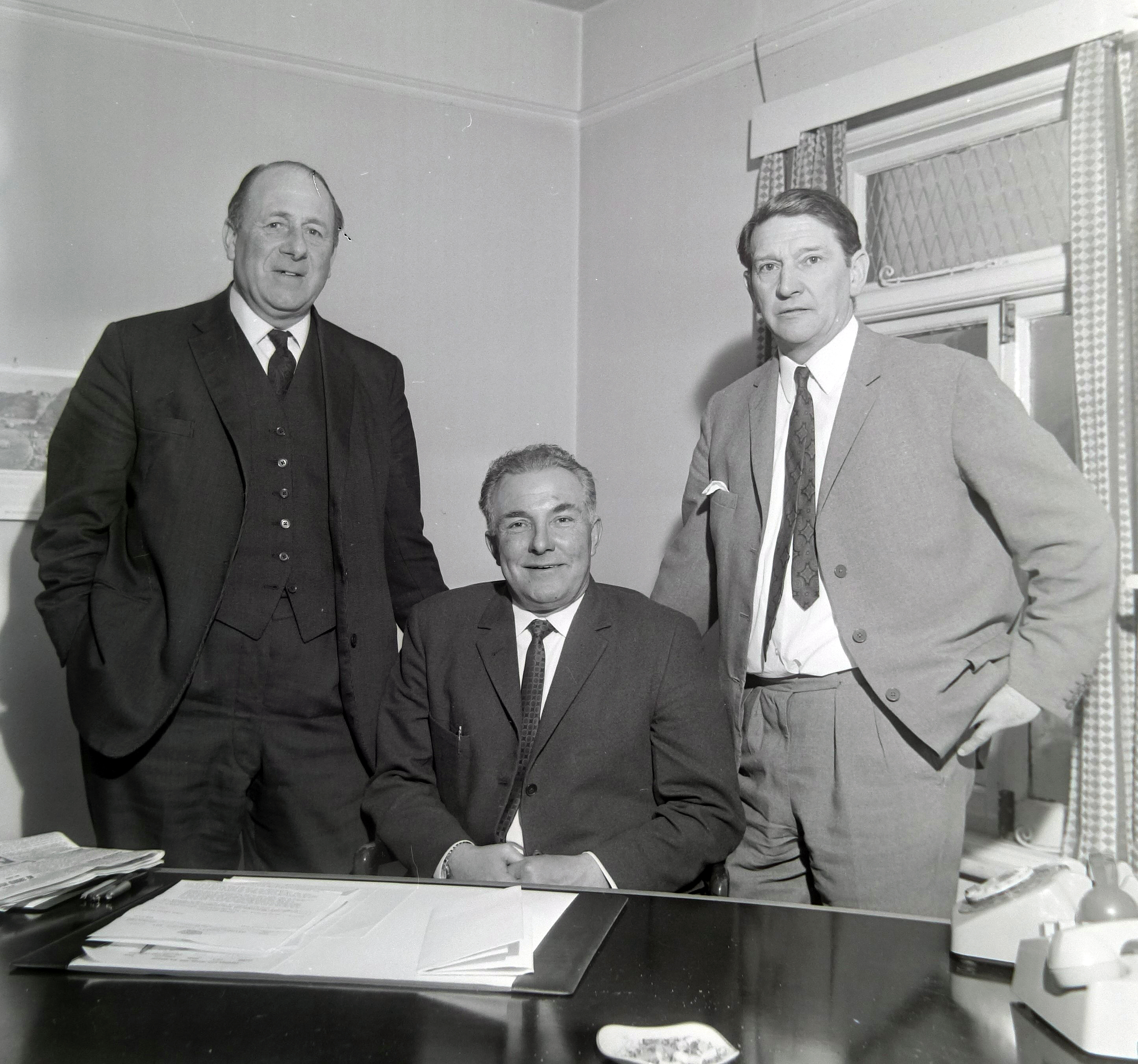
Below: Haslam joins the club in 1969, flanked by Len Hawkins (left) and Alec Stock.
Harry Haslam stepped into the role of manager officially on
May 5th 1972. His first season is best remembered for a swashbuckling run to
the FA Cup Quarter Final, during which Newcastle were disposed of 2-0 at St
James’ Park followed by a tremendous 1-0 victory at Burnden Park in the 5th
Round against Bolton, who had been unbeaten for 26 games at home. Hopes had
been high for another away success away in the Quarter Final against
Sunderland, a team Haslam’s Hatters had done the double over during the season,
but in the end an injury hit side fell 2-0 at a heaving Roker Park.
Around that time a young manager by the name of David Pleat
had been sacked by Nuneaton Town. Haslam was an admirer, and though he had no
coaching positions available, hired Pleat anyway, leaving the future Town
manager to sell Lottery Tickets and Spot The Ball Coupons until a position
became available!
A similar story can be found with the recruitment of Danny
Bergara. The Uruguayan had moved to St. Albans with his English-born wife at
the end of his playing career and had intended to open a travel business. That
was until Town scout Paddy Sowden, a friend of a friend, showed Bergara’s notes
on football to Haslam, who was impressed with what he read. However, unable to
sign a foreign national in a playing or coaching role at the time Haslam had to
come up with a workaround, and ended up convincing one of the directors to hire
Bergara as a chauffeur, thus enabling him to obtain a National Insurance
Number.
Haslam was no tracksuit manager nor particularly interested
in tactics. He had brought in ex-Norwich player Roy McCrohan as his coach, and
the ‘Sergeant Major’ demeneour of McCrohan perfectly complimented Haslam’s more
avuncular style. ‘Unlike most English managers at the time he was no ranter –
he never got too upset,’ as John Ryan, another of Haslam’s discoveries,
explained to Luton fan Joseph Press in a recent interview.
The following season brought about a change of colours, from
white to orange, and a new goalscoring hero at Kenilworth Road in the form of
Barry ‘The Bullet’ Butlin. His 18 goals, coupled with shrewd formational
changes and a superb core of players such as Alan Garner, Peter Anderson, John
Faulkner, Bobby Thomson and John Aston, saw Town promoted to the 1st Division
for the first time in 14 years. The promotion was secured in a 1-1 draw at West
Bromwich Albion, during which a nervous Haslam chain smoked almost throughout.
After a lifetime in the game Haslam had finally reached the
pinnacle. However it was tough going and at the turn of the new year his side
were routed to the bottom of the table. Haslam found the strain almost
unbearable and the season hit a low point with the sale of Barry Butlin to
Nottingham Forest. Form improved in the new year though and safety was very
nearly secured, but relegation was eventually confirmed after Tottenham secured
the point they needed in their last game.
That Town had reached the top flight was remarkable in
itself, and in large part testament to the culture Haslam and McCrohan had
created, as well as Harry’s eye for a player. The next two seasons brought
about credible top 10 finishes in the 2nd Division but they came in a period of
continued financial turmoil, the nadir of which came when Peter Anderson was
sold to Royal Antwerp in a deal that was said to have saved the club from
disaster.
One upside of this need to reduce costs was the
opportunities it afforded to the young players that Pleat and Bergara had been
nurturing in the youth set up. Debuts were handed to Godfrey Ingram, Brian
Stein and, on a famous day in April 1976, a 17-year-old Ricky Hill, who Haslam
nicknamed ‘Smiler’ on account of his sunny disposition.
But the financial situation continued to wear Haslam down. He
was approached by ambitious Sheffield United chairman Derek Dooley in 1978 and
accepted the offer after being refused an extended contract at Kenilworth Road.
Then, in one of those moments upon which football sometimes hinges, he tried to
take both Bergara and Pleat with him. Bergara, knowing his opportunities were
limited at Luton, accepted the offer. Pleat remained, and was able to build on
the foundations built by his predecessor.
Haslam’s time in Sheffield was not a happy one but is
punctuated by a now famous story of very nearly signing a young Diego Maradona
for the Yorkshire club. In-fact the deal was said to be all but done until the
Junta controlling Argentina demanded more money. It would have been the ultimate
deal for the ultimate ‘wheeler-dealer’!
Sadly Harry died suddenly in 1986 and is buried in the
village of Southill in Bedfordshire, not far from the lake at which he spent
many hours partaking in one of his other great loves, fishing. He is remembered
by many who played or worked for him simply as, ‘boss’.
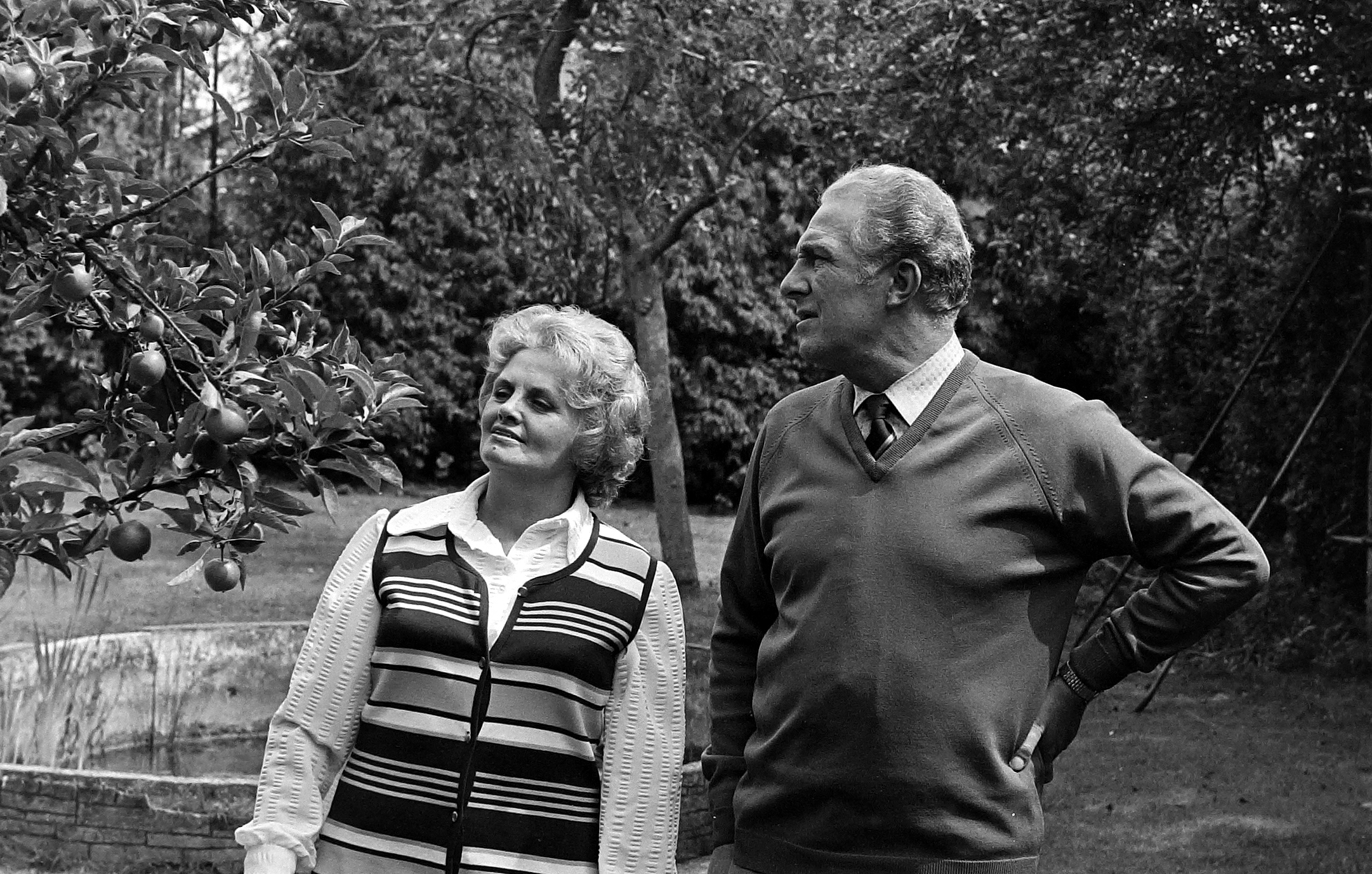
Below: Haslam with wife Trudi