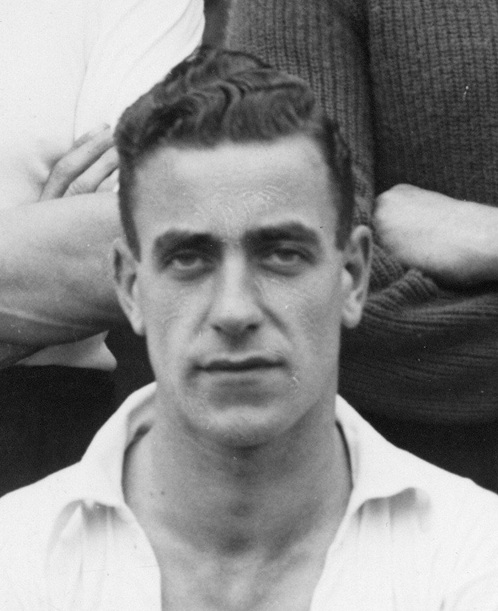
hot shot hughie
By Will Foster
At a concert for Tommies in April 1940 the entertainer noted
they had a soccer star in their midst. Indeed the player had sat atop the 2nd
Division scoring charts at the outbreak of war. Poor Hugh Billington, the
bashful, humble man the crowd turned towards, could not have been more
embarrassed by the attention.
‘I shan’t go to another concert for a long time,’ he told an
interviewer.
Hugh was born in Ampthill in 1916 but grew up in Luton. He
was living on Inkerman Street around the time Luton finally managed to persuade
him to turn professional in the summer of 1938, leaving behind an incredible
spell at Waterlows where his 100 plus goals, including 80 in a single season,
had helped the Dunstable side to two Spartan League titles. Billington would
later admit he preferred the amateur life, ‘we could go out for a drink with
our wives after matches. You couldn’t do that once you were a professional!’
He joined a club looking for someone to take on the
uneviable role of replacing Joe Payne, who had departed for Chelsea the
previous March. At first it was hoped Jack Vinall would be the next in line but
injury and loss of form led Town to turn to Billington, who had banged in 14
goals in 15 reserve games, by the time they visited Tranmere on Guy Fawkes
night.
‘I was more anxious that day than I’d ever been,’ Hugh said in a 1939 interview, ‘and I can tell you it was a great relief when I saw the ball going into the net for my first league goal.’ He would score again for good measure, helping Luton to a 3-2 win.
It began an incredible goalscoring record in Luton colours.
He managed 28 in his first 30 appearances, a number bettered to this day only
by Joe Payne’s 35, and ended his first season in the professional game as the 2nd
Division’s (now Championship) top scorer. It helped the club to a 7th placed
finish, the highest ever achieved in the Football League at the time. All this
less than 12 months after turning out in the Spartan League!
Southampton were to suffer particularly badly in the face of
his goalscoring prowess. Over the course of the 1939 Easter Weekend Billington
first hammered a hat-trick in a 6-3 win at Kenilworth Road, before equalling
the feat three days later in a 4-0 victory at The Dell. They were two of the
eight hat-tricks he scored in a Luton shirt. Only Gordon Turner, Ernie Simms,
Andy Rennie and Joe Payne have managed more.
Naturally this led to scouts descending on Kenilworth Road,
with visitors from Liverpool, Norwich, West Brom, Blackpool and Birmingham
among the suitors. The Luton directors, seeing 1st Division football so
tantalisingly near, were determined not to sell though, and Billington was
still around when football was halted after only three games of the 1939/1940
season. Not only was Billington topping the scoring charts, as that entertainer
would note a few months later, but Town were heading the division.
Hugh was called up to the Army in March 1940 but continued
to play for Town in wartime matches while on leave. Two months earlier, writing
in the Sunday Express, journalist John Wadham had ruminated on what Billington
might have been worth in peacetime conditions. ‘£10,000 and a not a sixpence
less,’ was his deliberation, a remarkable number give the British transfer
record stood just £4,000 higher at the time.
Hugh returned to football at the end of the war but was now
30. Still, in the first League match back at Kenilworth Road, a 4-1 win against
Sheffield Wednesday, it was said that the visitor’s proccupation with
Billington was a large reason when Mel Daniel was left with the space to score
a hat-trick.
In all he managed 28 goals in 40 goals in the first season
back. This included five in the 6-0 win against Notts County at Kenilworth Road
in January, the only time a Luton player has achieved such a feat in the FA
Cup. The following season the unthinkable happened and Billington, in the midst
of a poor run of form in which he’d only scored once In eight games, was dropped
to the reserves by manager Dally Duncan, who felt his star player needed a
rest. Hugh was apparently in agreement, though he was back in the first team by
the time Chelsea came calling in March.
In the end it was apparently ‘only’ £8,000 needed to secure
his services, with Hugh moving to Stamford Bridge alongside Billy Hughes in a
£20,000 deal. He would spend three season there before eventually hanging up
his boots after a short spell at Worcester City. He lived in Luton until his
passing in 1988, when he was survived by his wife Rene.
To many young supporters of the era Billington was their hero. This included Frank Batt who, in a 2010 Supporter’s Club Fanzine article wrote, ‘he was the best centre-forward I have ever seen at Luton…. after the war with little to distract us and no television soccer to taint our biased views, we knew that Hughie was the best thing even before sliced bread.’
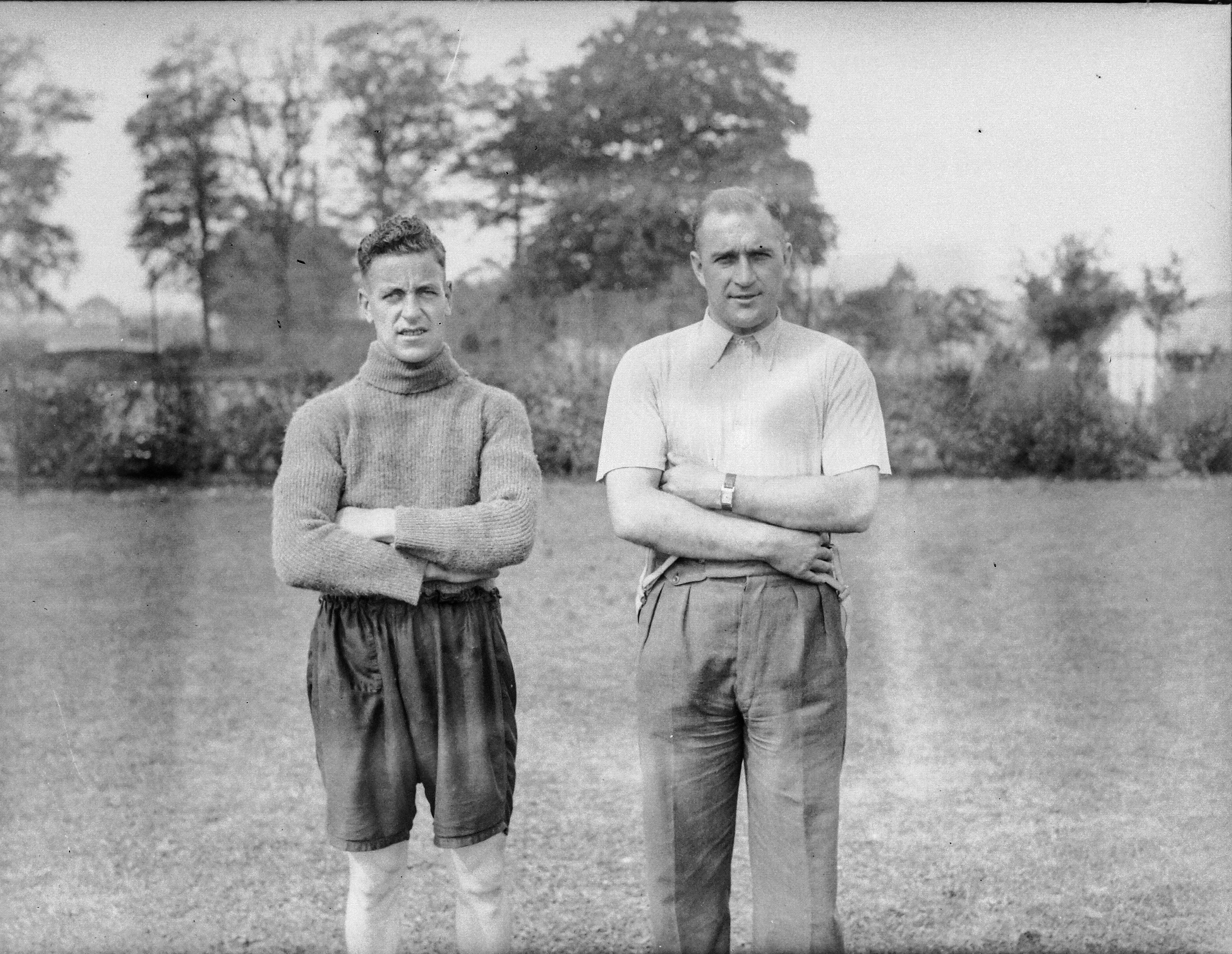
Below: Hugh (left) with trainer Tom Mackey